Last Updated: October 28, 2026
Quick Summary
Recruiting licensed applicators starts with confirming the exact license category your role requires, such as SUBT, and posting a clear job description. Search licensed operator registries and trade job boards, then verify every license against the state agency database before making an offer.
- Confirm the exact license category, such as SUBT, before posting the job.
- List the required license, pay range, schedule and core duties in every posting.
- Search licensed operator registries and trade association job boards for candidates.
- Verify every license on the state agency database rather than accepting screenshots.
- Check reciprocity rules for out-of-state candidates before extending an offer.
Table of Contents
- What SUBT Means and Which License It Refers To
- Writing a Pesticide Applicator Job Description That Attracts Qualified Candidates
- Where to Find Licensed Pest Applicators
- How to Verify a Pesticide Applicator License
- Recruiting Across State Licensing Rules
- Pest Control Technician Interview Questions and Screening Steps
- Pest Control Technician Hiring Checklist and Next Steps for Your Team
- Frequently Asked Questions
A focused approach can help organize recruiting for licensed pest control applicators. Some operators seek specialized credentials like SUBT. PEST CONTROL LICENSE connects certified operators with businesses across the continental United States, and this guide walks through how to recruit licensed SUBT applicators step by step.
The first step is knowing exactly what you are hiring for. The license category, state rules and job duties all shape who you should target and how you should screen them.
What SUBT Means and Which License It Refers To
SUBT is a pesticide applicator certification category tied to specific types of pest control work. The exact meaning of SUBT depends on the state where your business operates.
Before you post a job, confirm two things:
- The category name and scope. Know which pest control activities the license covers.
- Renewal and continuing education rules. A license that is close to expiring may affect your staffing plans.
Watch out:
Writing a Pesticide Applicator Job Description That Attracts Qualified Candidates
A clear job description can help describe the role to applicants. List the required license category by its exact name, not a general phrase like “pest license.”
Include these details in every posting:
- The exact license required, such as SUBT, and the state that issues it
- Core duties, including inspections, treatments and documentation
- Pay range and whether the role is full-time or part-time
- Schedule expectations and on-site versus remote work
- Physical requirements, such as lifting and climbing
Keep the language plain. Use plain language and clear requirements.
Where to Find Licensed Pest Applicators
When recruiting licensed applicators, consider where credentialed people may look.
- Industry job boards. Pest control specific boards draw candidates who already hold licenses.
- Trade associations. Membership directories and career pages reach working professionals.
- Direct outreach through a licensed operator registry. PEST CONTROL LICENSE offers a free, confidential registry where certified operators can list their credentials and where employers can search for matches. Operators who want to keep their search private can do so, which many experienced technicians prefer.
- Referrals from current staff. Ask your existing licensed technicians if they know peers who want new opportunities.
Confidentiality matters here. A confidential registration process is available through PEST CONTROL LICENSE.
How to Verify a Pesticide Applicator License
Check a candidate’s credential as part of your hiring process. Treat this as a due-diligence workflow.
Step 1: Collect the right identifiers up front
Consider asking candidates for these data points:
- Full legal name as it appears on the license
- License or certification number
- Issuing state agency (not just the state, the specific department or division)
- License category code and expiration date
Keep a record of the information you collect. Follow up if a candidate cannot provide a license number.
Step 2: Look up the license on the state database
Check with the relevant state agency about license verification. Confirm the applicable details:
- Status, active, expired, suspended, or revoked. Review the license status and applicable requirements before making a hiring decision.
- Category, the code must match the work you need. Check whether the candidate’s category matches the work required for the role.
- Expiration date, a license expiring within your onboarding window creates a scheduling risk. Note the date and plan a renewal conversation before the start date.
- Continuing education or recertification status, Check with the relevant agency about continuing education or recertification requirements.
State pesticide license lookup directory
Step 3: Match the category to the actual job duties
Before extending an offer, compare the candidate’s license category with the duties in your job description and check applicable requirements with the relevant agency.
Do not accept a screenshot of a license card as verification. Screenshots are easy to alter and do not show current status. Always confirm against the live agency database or a written verification from the agency.
::: Rigorous diligence remains the most effective defense against unqualified contractors, and establishing a consistent protocol to verify professional licenses ensures that every technician meets the necessary safety and regulatory standards.
Step 4: Document the verification in the applicant file
You may wish to keep a record of what you checked and found. For example:
- The lookup date and the name of the person who performed it
- A print-to-PDF or screenshot of the agency result page
- The license number, category, and expiration date as shown
- Any follow-up call or email with the agency, including the representative’s name
Consider your company’s recordkeeping policy and applicable requirements when deciding how to retain employment applications and license records.
Step 5: Handle gaps and red flags consistently
Decide in advance how your hiring process will address license-status or category questions:
- Expired within the last 90 days: ask whether renewal is in process and request proof of a scheduled exam or CE completion.
- Wrong category: treat as unlicensed for your purposes unless the candidate can obtain the correct category before the start date.
- Cannot be found in the database: ask the candidate to confirm the spelling of their name and license number, then call the agency directly. Do not proceed on verbal assurance alone.
Consider including credential verification in your hiring process.
Recruiting Across State Licensing Rules
If you recruit across state lines, check the applicable licensing requirements with the relevant agencies.
Understand the three paths a candidate can take
Check with the relevant agency about the requirements for out-of-state applicants:
- Reciprocity or endorsement: the state accepts a valid license from another state, sometimes with a short application and fee, and sometimes with a requirement that the candidate have a certain number of years of experience.
- Examination with partial credit: the candidate must sit for the state’s exam but may be exempt from portions of it based on their existing license and experience.
- Full re-licensure: the candidate must complete the state’s application, exam, and possibly a training requirement as if they were new to the field.
Check applicable requirements with the relevant agency before making an offer.
Build a reciprocity checklist for each state you hire into
For each location where you plan to hire, consider tracking relevant licensing requirements:
- What requirements apply to out-of-state licenses?
- Which agency, if any, handles the application?
- What examination requirements apply?
- What is the application review process?
- What continuing education or training requirements apply?
- Are there other applicable requirements?
Review your notes periodically and check current requirements with the relevant agency.
Decide who pays for what before the offer
Decide in advance how any applicable costs will be handled and communicate that arrangement to the candidate.
Check with the relevant agency about any requirements that apply before a candidate begins work.
Plan the timeline into your start date
Check any applicable application timeline with the relevant agency and discuss timing with the candidate.
Weigh in-state candidates against out-of-state transfers
Consider applicable licensing requirements when evaluating in-state and out-of-state candidates.
When recruiting across state lines, check applicable licensing requirements and consider them in your hiring plans.
Pest Control Technician Interview Questions and Screening Steps
A structured screening process can help organize candidate interviews.
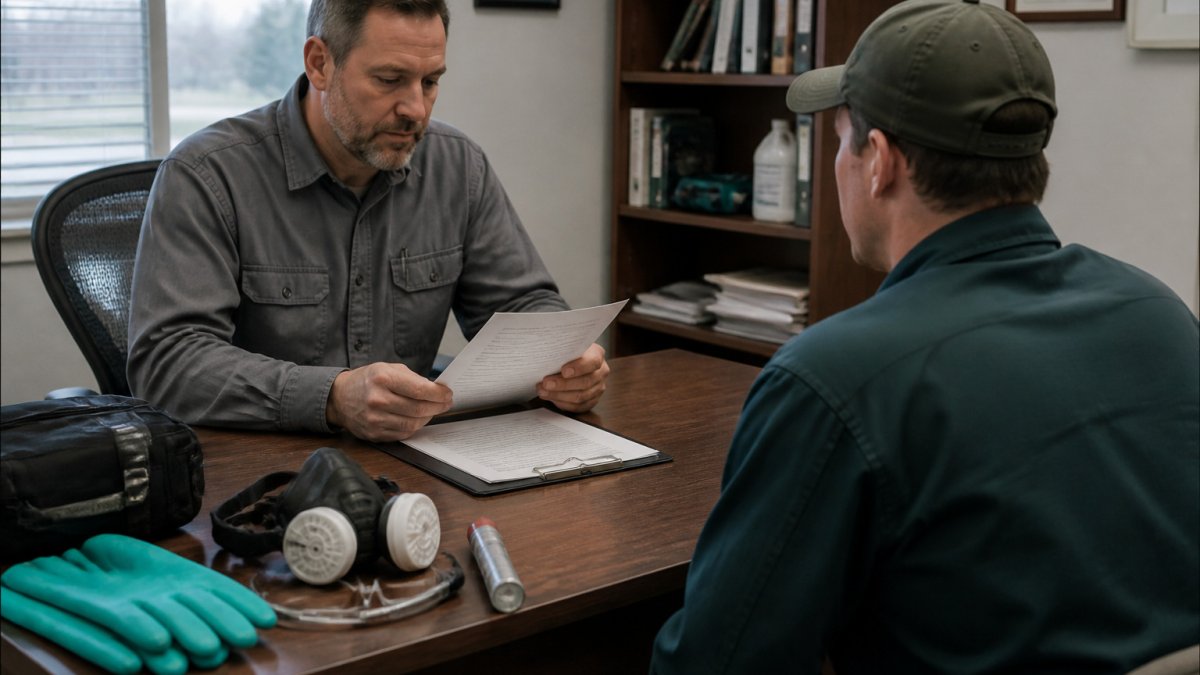
Useful questions include:
- Which license categories do you hold, and when do they expire?
- Describe a treatment job where you had to adjust your approach on site.
- How do you document a pesticide application for customer records?
- What safety steps do you follow when working around children or pets?
- What kind of schedule and pay structure are you looking for?
Choose screening steps that fit your hiring process.
Pest Control Technician Hiring Checklist and Next Steps for Your Team
Use this checklist as a starting point for your hiring process:
- Confirm the exact license category required, such as SUBT
- Post a clear job description with pay, schedule and duties
- Search licensed operator registries and trade job boards
- Verify every license on the state agency’s database
- Confirm reciprocity rules for out-of-state candidates
- Run structured interviews with the same core questions
- Check references and past treatment documentation
- Document the verification and offer in the applicant file
Once you identify a candidate, consider your next steps and how you will support technicians after onboarding.
If you are ready to start, register for free with PEST CONTROL LICENSE to connect with licensed operators across the continental United States.
The checklist below summarises the core steps for hiring a licensed SUBT pest applicator.
| Step | What to do | Note |
|---|---|---|
| Confirm license category | Confirm the exact category required, such as SUBT | Name must be exact |
| Post job description | List pay, schedule and duties | Clear, plain language |
| Search registries | Check licensed operator registries and trade job boards | Target licensed candidates |
| Verify license | Check every license on the state agency database | Do not rely on screenshots |
| Confirm reciprocity | Check rules for out-of-state candidates | Varies by state |
| Interview | Run structured interviews with the same core questions | Keep questions consistent |
| Check references | Review references and past treatment documentation | Confirm past work |
| Document | Record the verification and offer in the applicant file | Keep a clear audit trail |
Frequently Asked Questions
Where can employers find licensed pest applicators?
Employers can look for licensed pest applicators through job boards and referrals from current staff. Consider specifying the license class you need, such as SUBT or GHP, in a job listing.
How do you verify a pest control applicator’s license?
Check with the relevant agency about how to verify an applicant’s license. Review the credential details relevant to the role and keep a record of your verification.
What questions should you ask when interviewing a pest control technician?
Ask which license categories the candidate holds and about their relevant work experience. You can also ask about their experience with inspections and customer communication.
Can a pest control company hire an applicator who is still working toward certification?
Whether a company can hire an applicator who is still working toward certification depends on applicable requirements. Check with the relevant agency before making a hiring decision.
